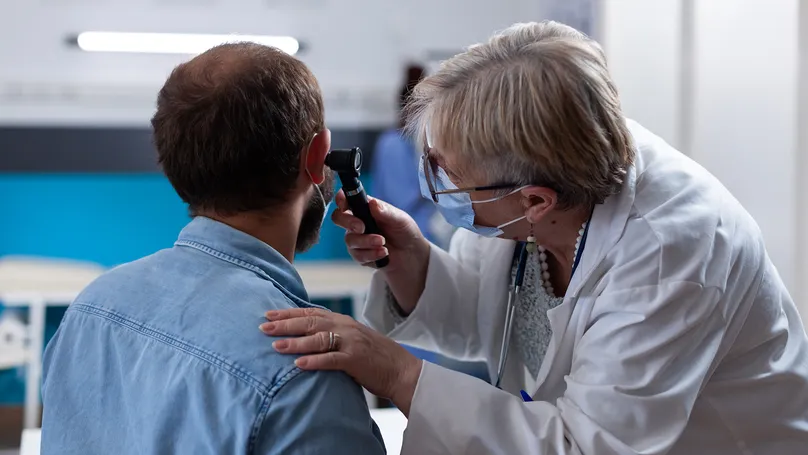
Protect your brain health by caring for your hearing. Simple, regular checks can make a big difference for healthy ageing.
This article was reviewed by experts at the Centre for Healthy Brain Ageing (CHeBA).
Hearing and brain health are linked
Many people put off hearing checks, but untreated hearing loss is one of the most common and preventable risk factors for cognitive decline. Cognitive decline is the loss of thinking skills (such as memory) that can happen with age.
If your family members or friends are commenting on your hearing, it’s worth getting your hearing checked. If you’ve noticed you can’t hear sounds that others can, that’s a sign to act now.
The good news is that regular hearing tests are quick, painless, and can make a big difference. Catching changes early helps you stay connected and confident. This helps you support your brain and thinking skills as you get older.
How hearing checks help
During a hearing check, your clinician can suggest simple ways to manage hearing loss, such as:
Subsidised hearing devices
Communication strategies (like talking face-to-face)
Tips to protect your hearing from further damage
If you’re advised to use a hearing device, wear it consistently and give yourself time to adjust. If hearing aids still feel challenging, there are alternative therapies to explore. Your audiologist can help you find the right support.
5 reasons to get your hearing checked regularly
Want to know why it's so important to have your hearing checked and use hearing support when needed? Here are 5 reasons to get regular hearing tests:
To protect your brain and memory – Hearing keeps your brain active and your thinking skills strong. Staying on top of your hearing health supports your thinking skills.
To stay socially connected – Hearing loss can lead to isolation and loneliness. Hearing support helps keep you confident and connected, which supports your brain and body.
To reduce your risk of dementia – Hearing loss is a modifiable risk factor for dementia. Early detection and hearing support reduce this risk.
To improve your quality of life – Looking after your hearing helps your brain, social life, and mental health. Together, these benefits boost independence and quality of life.
It’s quick and easy to do – Hearing checks are free and take only a few minutes, so why not book one today?
Did you find this article useful?
Your feedback helps LiveUp to curate information that matters to you.
You might also be interested in these resources
How to improve brain health for older people
Learn how to protect your cognitive health as you age.
Untreated hearing loss forces your brain to work harder to make sense of sound. According to the consensus Framework for Understanding Effortful Listening (FUEL), this extra effort uses up mental energy. It makes it harder to understand or remember what’s being said. Over time, this can increase stress and fatigue.
A 2020 study found that even mild hearing loss in older adults is linked to poorer performance on cognitive tests. Hearing loss can sometimes look like memory or thinking problems – but it could just be fatigue making things harder.
Listening to conversations engages several brain regions at once. It's a good ‘mental workout’, when fatigue isn't in the way. Hearing loss can reduce this benefit.
Regular hearing checks help you get timely support. This helps you keep your listening skills strong. This, in turn, keeps your brain engaged – supporting your thinking and memory as you age.
Stay socially connected
Good hearing helps you stay engaged with the people and activities you enjoy.
Age-related hearing loss often makes it harder to follow speech. This is especially the case in noisy environments or when several people talk at once.
This might cause you to withdraw from or avoid conversations. You may become more isolated or lonely. This affects your mental, physical, and brain health.
Social activity is a great mental workout and essential for healthy ageing. It plays a vital role in protecting the brain from dementia. Recent research from the Centre for Healthy Brain Ageing (CHeBA) backs this. You can learn more about it in a new National Geographic documentary featuring Chris Hemsworth.
Social isolation is the biggest modifiable risk factor for dementia in later life.
— Dr Samtani from CHeBA
Hearing checks and early support can help you stay confident and connected, so you can stay healthy as you age.
Reduce dementia risk
Dementia is a syndrome caused by many diseases. It’s defined as cognitive decline interfering with day-to-day function.
Hearing loss is linked to a higher risk of dementia. The exact reason is still unclear. Factors such as brain tissue changes, social isolation, and depression may all play a role.
The good news is that treatment can make a difference:
A 2023 clinical trial in The Lancet found that using hearing aids with proper guidance slowed cognitive decline by around 48% over 3 years in adults aged 70–84 who also had heart-related risk factors for dementia, like diabetes or high blood pressure.
Timing matters too. A 2025 study in JAMA Neurology showed that starting hearing aid use before age 70 had a stronger impact. It lowered dementia risk by 61%over 20 years compared to untreated hearing loss. This benefit was seen regardless of heart health – but not in people who began after 70.
The key takeaway: early support does the most to reduce dementia risk from hearing loss. Regular hearing checks make this possible.
Improve your quality of life
Supporting your hearing can be simple and cost-effective. It can also make daily life easier.
Better communication skills boost confidence at work and in social settings.
Hearing support also increases personal safety. It helps you hear important sounds like alarms and traffic. This can empower you to keep going out and living your life the way you want.
Treating hearing loss helps you stay connected, active, and independent – which all improve your quality of life.
Hearing tests are quick and easy to do!
Hearing tests are painless and quick. They’re widely available through GPs, audiologists, and online screening tools – often for free.
If you visit a clinic that offers free testing, remember you don’t have to buy anything on the spot. Take your time to review your results.
A reputable audiologist will give you clear information and support you to choose what feels right for you.
Learn more about what’s involved and how to prepare for your appointment by visiting health.gov.au.
Francis, L., Seshadri, S., Dillard, L. K., et al. (2025). Self-reported hearing aid use and risk of incident dementia. JAMA Neurology, 82(11), 1195–1197. 10.1001/jamaneurol.2025.2713
Golub, J. S., Brickman, A. M., Ciarleglio, A. J., Schupf, N., & Luchsinger, J. A. (2020). Association of Subclinical Hearing Loss With Cognitive Performance. JAMA otolaryngology-- head & neck surgery, 146(1), 57–67. https://doi.org/10.1001/jamaoto.2019.3375
Jiang, D., Hou, J., Nan, H., et al. (2024). Relationship between hearing impairment and dementia and cognitive function: A Mendelian randomization study. Alzheimer’s Research & Therapy, 16, 215. https://doi.org/10.1186/s13195-024-01586-6
Kirschen, R. M., & Leaver, A. M. (2024). Hearing function moderates age-related differences in brain morphometry in the HCP Aging cohort. Human Brain Mapping, 45(16), e70074. https://doi.org/10.1002/hbm.70074
Lin FR, Albert MS, Sharrett AR, et al. (2023). Hearing intervention versus health education control to reduce cognitive decline in older adults with hearing loss in the USA (ACHIEVE): a multicentre, randomised controlled trial. Lancet, 402(10396):786-797. doi:10.1016/S0140-6736(23)01406-X. thelancet.com
Pichora-Fuller, M. K., Kramer, S. E., Eckert, M. A., Edwards, B., Hornsby, B. W., Humes, L. E., Lemke, U., Lunner, T., Matthen, M., Mackersie, C. L., Naylor, G., Phillips, N. A., Richter, M., Rudner, M., Sommers, M. S., Tremblay, K. L., & Wingfield, A. (2016). Hearing Impairment and Cognitive Energy: The Framework for Understanding Effortful Listening (FUEL). Ear and hearing, 37 Suppl 1, 5S–27S. https://doi.org/10.1097/AUD.0000000000000312
Wang, H.-F., Zhang, W., Rolls, E. T., Li, Y., Wang, L., Ma, Y.-H., Kang, J., Feng, J., Yu, J.-T., & Cheng, W. (2022). Hearing impairment is associated with cognitive decline, brain atrophy and tau pathology. EBioMedicine, 86, 104336. https://doi.org/10.1016/j.ebiom.2022.104336
LiveUp provides free information to help you make informed decisions about your health. This information is for general and educational purposes only, is not intended to provide a comprehensive guide, and does not replace medical advice. Everyone is different, so some of these tips may work better for you than others. You should use your own judgment and seek medical advice when applying this information to yourself, to determine if it is suitable in your circumstances. Your use of, or reliance on, this information is solely at your own risk. Independent Living Assessment Incorporated is not responsible or liable for any injury, loss, or damage caused as a result of your use of, or reliance on, this information.
Download and print this article:
You can print out the PDF and stick it to your fridge or file away the tips to revisit at a later time.
Read more Memory articles
Did you enjoy this article? You may also like reading similar healthy ageing articles.