Why dual tasking is a game changer for healthy ageing
4 minute readShare this article
Learn how doing two things at once can support your brain, body, and independence. Try some beginner-friendly examples of dual tasking.
This article was written in collaboration with Associate Professor Kristy Robson PhD, Senior Research Fellow, Charles Sturt University, Co-founder of Wellness 2 Age: https://wellness2age.csu.edu.au/
What is dual tasking and why does it matter?
Dual tasking is a type of multitasking where you do two tasks at the same time. You do this by splitting your attention between them.
Many everyday situations require you to combine a movement task with a thinking task. This is called motor-cognitive dual tasking. Here are some examples:
Walking while planning what you need to get from the store
Stepping around obstacles while carrying objects
Packing things away while having a conversation
As you age, your ability to dual task can decrease. But you can improve it by doing regular dual-task exercises.
Motor-cognitive dual task training is particularly helpful for healthy ageing. It trains the brain and body together, boosting important skills like coordination and memory.
The benefits of dual tasking for healthy ageing
Better thinking skills
Motor‑cognitive dual task training is good for brain health. Research shows it's one of the most promising approaches for supporting thinking skills in healthy older adults. It is especially helpful for:
Attention
Reaction time
Executive skills like planning, decision‑making, and everyday multitasking
Studies show the improvements are usually small, but even small changes can matter. They can make day‑to‑day activities feel easier and safer.
Better physical stability
Studies also show that dual task training can improve:
Gait (walking pattern)
Muscle strength
Balance
For these effects, dual motor task training is most effective. That means doing two different movements simultaneously.
Did you find this article useful?
Your feedback helps LiveUp to curate information that matters to you.
You might also be interested in these resources
How to improve brain health for older people
Learn how to protect your cognitive health as you age.
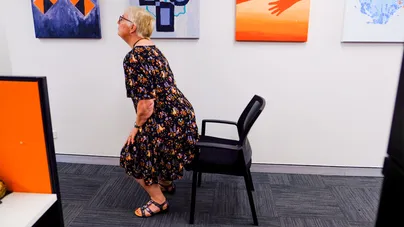
Strengthen your lower body and improve mobility with the sit-to-stand exercise. Learn how this simple exercise can boost balance and independence for older adults.
A basic example of dual motor tasking could be passing a cushion from hand to hand while marching in place.
Reduced risk of falls
Balance, mobility, and reaction time all play a role in preventing stumbles. So, improvements in these areas may help lower your risk of falling.
Over time, this can help you feel more confident and steady during everyday tasks.
Supporting your independence
Together, these benefits help you stay active and confident in daily life. Better brain and body health work together to protect your independence as you age.
So, why not add a few small dual-task exercises to your daily routine?
Motor-cognitive dual task activities you can try today
Here are some practical, beginner-friendly ideas you can try out.
If you’re unsure about trying new exercises or movements, consult your doctor first.
Important: Always prioritise stability. If you feel unsteady while doing an exercise, pause the thinking task and focus on your balance first.
Basic but practical everyday examples
Try adding a few of these exercises onto your existing routine:
In the kitchen
March in place while waiting for the kettle to boil and name fruits alphabetically.
Stand at the bench and shift weight side to side while recalling yesterday’s events.
In the bathroom
Brush your teeth or hair with your non-dominant hand.
During TV time
Sit-to-stand from your chair during ad breaks while counting backwards from 50.
Pass a cushion from hand to hand while answering trivia questions.
While walking
Walk in a hallway near a wall while naming words that start with a chosen letter.
Walk at your usual pace and clap every time you see a specified colour object.
At the supermarket
Push the trolley and mentally calculate the total cost of items.
Motor-cognitive dual task progression ladder
Want to develop your ability? Try progressing through these difficulty stages at a pace that’s comfortable for you:
Level 1
Stand with feet hip-width apart while naming animals or favourite foods.
Level 2
Stand with feet closer together while counting backwards by ones.
Level 3
Shift weight gently side to side while planning your shopping list.
Level 4 (if steady)
Try a single-leg stance while naming cities or doing simple maths.
Tips for success and safety
Choose a safe space with support nearby, such as a chair or wall.
Start with simple tasks and progress slowly.
If unsure, consult your GP or allied health professional.
Take charge of your health today
Try one of the dual tasks listed above to see how easy it is to support your health.
You can also check out some of LiveUp’s other resources for improving balance and brain health:
Bier, B., Lecavalier, N. C., Malenfant, D., Peretz, I., & Belleville, S. (2017). Effect of Age on Attentional Control in Dual-Tasking. Experimental aging research, 43(2), 161–177. https://doi.org/10.1080/0361073X.2017.1276377
Hao, Y., Zhao, Y., Luo, H., et al. (2025). Comparative effectiveness of different dual task mode interventions on cognitive function in older adults with mild cognitive impairment or dementia: A systematic review and network meta-analysis. Aging Clinical and Experimental Research, 37, 139. https://doi.org/10.1007/s40520-025-03016-5
Nott, M. T., Robson, K. M., Murphy, K., Pope, R. P., Cuming, T., & Curtin, M. (2019). Ageing well: Pilot evaluation of a dual‐task training program in a rural community. Australian Journal of Rural Health. Advance online publication. https://doi.org/10.1111/ajr.12522
Tait, J. L., Duckham, R. L., Rantalainen, T., Milte, C. M., Main, L. C., Nowson, C. A., Sanders, K. M., Taaffe, D. R., Hill, K. D., Abbott, G., & Daly, R. M. (2025). Effects of a 6month dualtask, powerbased exercise program on cognitive function, neurological and inflammatory markers in older adults: Secondary analysis of a cluster randomised controlled trial. GeroScience, 47, 1251–1268. https://doi.org/10.1007/s11357-024-01316-8
Wollesen, B., Wildbredt, A., van Schooten, K. S., Lim, M. L., & Delbaere, K. (2020). The effects of cognitive-motor training interventions on executive functions in older people: a systematic review and meta-analysis. European review of aging and physical activity : official journal of the European Group for Research into Elderly and Physical Activity, 17, 9. https://doi.org/10.1186/s11556-020-00240-y
Download and print this article:
You can print out the PDF and stick it to your fridge or file away the tips to revisit at a later time.
Read more Memory articles
Did you enjoy this article? You may also like reading similar healthy ageing articles.