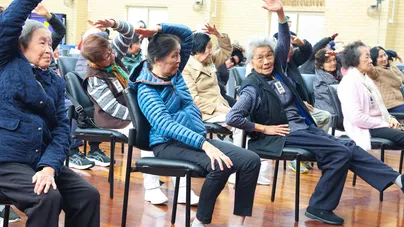
You can take charge of your health today and reduce your risk of falls. Here's how you can start.

Falling is the leading cause of injury in people aged 65 years and over. Falling can cause injury, pain, loss of confidence, and fear of falling. These factors in turn can reduce activity levels, quality of life and independence.
Almost 75% of people report slips, trips, and loss of balance as the cause of their fall.
The good news is that these factors can be dramatically improved. Strength, flexibility, balance, and reaction time are the easiest risk factors to address.
Being at risk, does not mean you will have a fall. If you have one or more of the following risk factors, you can take action to address them. Take extra care when completing certain tasks too. The risk factors for falls include:
Your risk of falling can be significantly reduced by:
Exercise can prevent falls in older people by decreasing many risk factors. Some of the benefits of exercise include:
Getting older could mean that even the thought of exercising is challenging. You might not know the safest way to start a new routine. You might worry about your body or your balance. You might be living with pain or a chronic condition.
There are lots of ways to address these concerns so that you can feel the benefit of regular exercise. Speak to your doctor for exercise advice. Visit an allied health professional for guidance and support. Join a condition-specific exercise class. Take advantage of local community groups.
Here are some low-risk exercise ideas to try at home or in your community. You'll be surprised how quickly you notice an improvement!
Balance and coordination exercises are very important for falls prevention. And strengthening exercises improve muscle stability, which is key for good balance. Strong muscles can also help protect you from injury in case you do fall.
Regular, ongoing practice is the most effective. Try a safe routine that gradually becomes more challenging over time.
To get you started, here are 10 simple balance exercises you can try now.
In a large scientific review, Tai Chi was found to successfully improve balance and decrease the rate of falls in older people. Tai Chi becomes more effective for falls prevention with increased practice.
Chair yoga is also good for your balance, even though this practice doesn't require you to get up from your chair. Certain stretches in chair yoga can help improve mobility in your spine and neck, which helps prevent falls.
Falls are preventable no matter your age. By exercising regularly, your strength, mobility, and balance can improve even after having a fall. Here are some helpful tips for practising falls prevention exercises:
You could try the following:
If you'd like to read more about falls prevention, click on these links:
Want to learn more about exercise and healthy ageing? Try another LiveUp article by choosing from the titles below. Just click the link to start reading:
Australia & New Zealand Falls Prevention Society. (2023). Info about falls. https://www.anzfallsprevention.org/info
Australian Institute of Health and Welfare. (2022, November 25). Falls. https://www.aihw.gov.au/reports/injury/falls
Exercise & Sports Science Australia. (2023, April 4). Balance training for falls prevention. Exercise Right. https://exerciseright.com.au/balance-training-for-falls-prevention
Healthdirect. (2021, July). Falls and the elderly – causes, treatments and prevention. https://www.healthdirect.gov.au/falls
Chen, W., Li, M., Li, H., Lin, Y., & Feng, Z. (2023). Tai Chi for fall prevention and balance improvement in older adults: A systematic review and meta-analysis of randomized controlled trials. Frontiers in Public Health, 11, 1236050. https://doi.org/10.3389/fpubh.2023.1236050
LiveUp provides free information to help you make informed decisions about your health. This information is for general and educational purposes only, is not intended to provide a comprehensive guide, and does not replace medical advice. Everyone is different, so some of these tips may work better for you than others. You should use your own judgment and seek medical advice when applying this information to yourself, to determine if it is suitable in your circumstances. Your use of, or reliance on, this information is solely at your own risk. Independent Living Assessment Incorporated is not responsible or liable for any injury, loss, or damage caused as a result of your use of, or reliance on, this information.
You can print out the PDF and stick it to your fridge or file away the tips to revisit at a later time.

Did you enjoy this article? You may also like reading similar healthy ageing articles.
See all Balance articlesYour feedback helps LiveUp to curate information that matters to you.