Tai Chi is a low-impact and affordable exercise with great benefits for older adults. Discover how Tai Chi can support your balance and overall health. Interested in trying it out at home? Follow along with our video demonstration.
Tai Chi is a gentle exercise option that's low in impact but high in reward. It makes use of slow and careful movements that continuously shift your centre of gravity. This allows you to practice your balance control.
Tai Chi is suitable for older adults and people with chronic illness. It can allow you to improve your health without exacerbating existing issues. It's accessible and versatile, too.
You can practice Tai Chi outside with others, or in the comfort and convenience of your own home. All in all, there are many reasons you should consider giving Tai Chi a go.
Hear from Tai Chi instructor Sam about Tai Chi's origins and benefits
The benefits of gentle exercise
Regular light exercise, such as Tai Chi or chair yoga, has many benefits for older people.
It helps you manage your cholesterol and blood pressure.
It helps with conditions such as type 2 diabetes, affecting how the body responds to insulin.
Regular movement reduces risk of bone fractures by maintaining bone density. This is useful in managing
Did you find this article useful?
Your feedback helps LiveUp to curate information that matters to you.
You might also be interested in these resources
Active & Healthy Tai Chi
Try tai chi and learn how to combine your breath, mindfulness, and movement. This helps to calm your nervous system. It improves your blood circulation and mobility. Classes are perfect for anyone who wants to improve overall health and well-being....
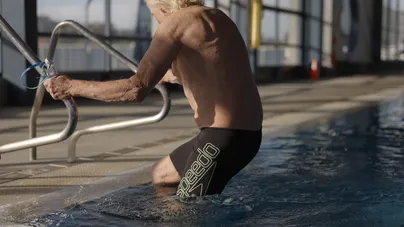
Discover the benefits of water aerobics for older adults. Learn how this low-impact exercise improves strength, flexibility, and cardiovascular health.
Tai Chi's health benefits are many and well-studied. Research supports that in older people Tai Chi can improve:
Cardiorespiratory fitness (heart and lung health)
Strength
Balance
Mobility
Sleep
Cognition (thinking skills)
It also reduces falls and stroke risk factors.
According to a 2023 literature review, Tai Chi improves mobility and balance in older people more effectively than conventional exercise.
Reduce your fear and risk of falling
Tai Chi has been found to successfully decrease the rate of falls in older people.
Doing Tai Chi practices skills such as:
Posture control
Trunk rotation
Weight transfer
Training these skills contributes to improving your balance.
Tai Chi also improves balance by training your:
Proprioception (your ability to sense your body's position in space)
Muscle strength (itstrengthens your upper and lower limbs, as well as the core muscles of your back and abdomen)
Flexibility and mobility
All this helps you recover from stumbling more easily, so you end up less afraid of falling. Feeling more confident also makes it even less likely you'll fall.
Tai Chi is what's known as a mind-body exercise. That means it combines gentle physical movement with focussed awareness. It often includes controlled breathing and sustained attention to how the body moves and feels. This promotes relaxation and calmness in your mind and body.
It’s also an opportunity to join a group and connect with people in your area. Staying connected with your community is an important aspect of your mental health. It's a big part of ageing well.
How do I get started with Tai Chi?
Getting started
First, put on loose, comfortable clothes. You can go barefoot or wear flexible shoes with thin soles. You should be able to find a class in your area by looking online or checking your nearest community centre. You can even observe a class before participating, in many cases. You can also follow videos online, if you prefer to try it out at home.
If you're opting to follow instructional videos at home, have someone join you. And choose somewhere nice to practice. Make sure you have room to extend your arms around you. Check there's nothing on the floor or in your way. It might also be nice to find a place with natural light and a pleasant view.
Staying safe
Before you begin any new exercises, remember to listen to your body. Stop and seek advice from a medical professional if you feel new or increasing pain, or if you feel dizzy, clammy, or short of breath. Some exercises may not be for you. Consult a medical professional if you are unsure.
Use Tai Chi to develop your fitness skills
You can practice Tai Chi a little bit every day. Soon enough, you might find you can exercise for a longer time each day. The Health Department recommends you do 30 minutes of moderate-intensity exercise on as many days as you can manage. But whatever you choose to do, even a little bit will go a long way. Get advice from your healthcare professional when planning a new exercise regimen.
Follow along with this Tai Chi demonstration video
More helpful information
If you would like to find local exercise classes, social activities, and helpful tips, try the quick quiz or call our helpful team free today on 1800 951 971.
You can also try these 10 chair yoga poses to improve your balance and mobility.
Hu, L., Wang, Y., Liu, X., et al. (2021). Tai Chi exercise can ameliorate physical and mental health of patients with knee osteoarthritis: Systematic review and meta-analysis. Clinical Rehabilitation, 35(1), 64-79. https://journals.sagepub.com/doi/10.1177/0269215520954343
Huang, Z., Feng, Y., Li, Y., et al. (2017). Systematic review and meta-analysis: Tai Chi for preventing falls in older adults. BMJ Open, 7(e013661). https://bmjopen.bmj.com/content/7/2/e013661
Li, Y., Liu, M., Zhou, K., Dong, G., Manor, B., Bao, D., & Zhou, J. (2023). The comparison between effects of Tai Chi and conventional exercise on functional mobility and balance in healthy older adults: A systematic literature review and meta-analysis. Frontiers in Public Health, 11, Article 1281144. https://www.frontiersin.org/journals/public-health/articles/10.3389/fpubh.2023.1281144/full
Park, M., Song, R., Ju, K., et al. (2023). Effects of Tai Chi and Qigong on cognitive and physical functions in older adults: Systematic review, meta-analysis, and meta-regression of randomized clinical trials. BMC Geriatrics, 23, 352. https://doi.org/10.1186/s12877-023-04070-2
Siu, P. M., Yu, A. P., Tam, B. T., et al. (2021). Effects of Tai Chi or exercise on sleep in older adults with insomnia: A randomized clinical trial. JAMA Network Open, 4(2), e2037199. https://doi.org/10.1001/jamanetworkopen.2020.37199
Yang, F. C., Desai, A. B., Esfahani, P., Sokolovskaya, T. V., & Bartlett, D. J. (2021). Effectiveness of Tai Chi for health promotion of older adults: A scoping review of meta-analyses. American Journal of Lifestyle Medicine, 16(6), 700-716. https://pmc.ncbi.nlm.nih.gov/articles/PMC9644143/
Zou, L., Xiao, T., Cao, C., et al. (2021). Tai Chi for chronic illness management: Synthesizing current evidence from meta-analyses of randomized controlled trials. The American Journal of Medicine, 134(2), 194–205.e12. https://www.amjmed.com/article/S0002-9343(20)30787-7/abstract
How to use this information
LiveUp provides free information to help you make informed decisions about your health. This information is for general and educational purposes only, is not intended to provide a comprehensive guide, and does not replace medical advice. Everyone is different, so some of these tips may work better for you than others. You should use your own judgment and seek medical advice when applying this information to yourself, to determine if it is suitable in your circumstances. Your use of, or reliance on, this information is solely at your own risk. Independent Living Assessment Incorporated is not responsible or liable for any injury, loss, or damage caused as a result of your use of, or reliance on, this information.
Download and print this article:
You can print out the PDF and stick it to your fridge or file away the tips to revisit at a later time.
Read more Fitness articles
Did you enjoy this article? You may also like reading similar healthy ageing articles.